Ish Williams and Ezra
Earth AbidesIsh Williams and Ezra’s friendship links the lonely years after the Great Disaster to the later life of The Tribe. Ezra is not a builder of technology or a visionary for restoring the old order; his distinctive gift is making people comfortable and helping them live with one another. Ish values that gift from their first meeting, misses Ezra after he leaves, and continues to seek his company long after the two men have grown old together in the community.
Arrival and First Friendship
During the early years of Ish and Em’s life at home, wanderers sometimes followed the smoke rising from San Lupo Drive. Most seemed, in Ish’s judgment, badly unsettled by the loss of the world they had known, and Ish and Em were often relieved when such visitors moved on. They were wary, too, of the complications that might come from a third person joining their household. Ezra was the exception: his arrival did not feel like one more encounter with a stranger who could not settle.
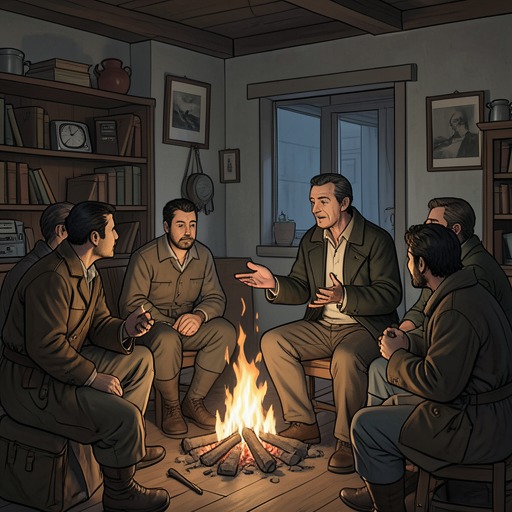
Ish remembered Ezra strolling down the street on a hot September day. Ezra’s face was florid, his half-bald head redder still, and his narrow, pinched jaw revealed bad teeth when he stopped and smiled at Ish. His greeting carried the trace of a North-of-England accent behind its American words. These details remained vivid in Ish’s memory, but what made Ezra matter was less his appearance than the welcome in his manner. He had what the narration describes as an exceptional ability to make people feel comfortable; even the babies smiled for him.
Ezra stayed until after the first rains. Ish and Em would have liked him to remain permanently, but their concern about the strain of a three-person household persisted even with someone as perceptive and easygoing as Ezra. When Ezra seemed restless, they encouraged him to continue his travels, joking that he should find a pretty girl and return with her. The joke did not make the parting painless: Ish and Em were sad when Ezra went away.
The Year of Ezra
Ezra’s departure became part of the community’s way of remembering time. When the sun had moved far to the south and Ish and Em went to the flat rock to cut the numeral 2, Ezra was still in their thoughts. They did not expect to see him again, but remembered him as someone who would have been a good helper and a good person to have around. They named the year for him: the Year of Ezra.
That naming gives the friendship a place in the community’s shared history. The year-marking is not simply a record of an absent guest; it preserves the importance Ish and Em attached to Ezra after he had gone. Their affection persists without any certainty of reunion, and Ezra’s brief stay becomes one of the personal landmarks by which the early years are recalled.
Friendship and the Work of Community
Later, when Ish considers what kind of people might form the foundations of a new civilization, he thinks of Ezra. The community has not restored the systems Ish once hoped might return, including electric lights, and remains dependent on what the past left behind. Ish sees the people around him as the bricks from which a different civilization must be made. Ezra belongs among those indispensable people, though Ish distinguishes his talent from the creative drive he thinks would produce a new civilization: Ezra’s genius, as Ish sees it, is living easily and amicably with others.
That judgment does not diminish Ezra’s importance. It identifies a kind of social capacity that cannot be replaced by salvaged equipment. Ezra’s friendliness makes him valuable not because he supplies Ish with a grand plan, but because he helps people feel at ease with one another. In a small and vulnerable community, the ability to sustain ordinary goodwill is itself a form of constructive work.
Support in Later Life
Ezra’s presence also steadies Ish in a moment when Ish is angered by Jack’s independence. After Jack leaves, Ezra quickly speaks to cover the awkwardness and invite Ish to continue explaining his ideas. His response is characteristically considerate, even flattering. Ish relaxes; instead of remaining angry at Jack for acting independently, he recognizes that Jack is a grown man rather than merely a boy and son. Ezra’s intervention does not settle Ish’s deeper worries, but it helps him turn the incident into an occasion to speak about the need to rebuild both material life and social organization.
Another later visit shows how naturally Ish seeks Ezra’s company. While going to see George about a water problem at home, Ish stops at Jean’s house to pick Ezra up—not because Ezra can repair the pipe or is needed for a negotiation, but simply because Ish likes seeing him. Jean tells him Ezra is staying at Molly’s that week. Ish is struck by the arrangement: Jean and Molly remain on good terms and help one another with household emergencies. He understands this as another consequence of Ezra’s ability to get along with people and help them get along with one another.
The smallness of the errand makes the friendship especially clear. Ish is dealing with a practical crisis, but Ezra’s value to him is not practical expertise. Ish seeks the familiar pleasure of his company, and Ezra’s influence is visible even in the cooperative relations between Jean and Molly. Across years of scarcity and change, their bond rests on that steady social gift: Ezra makes life among other people easier, and Ish knows how much that matters.